
FGIA Conference participants get first look at VIG research results from Michigan Technological University Study
Posted on September 3rd, 2026
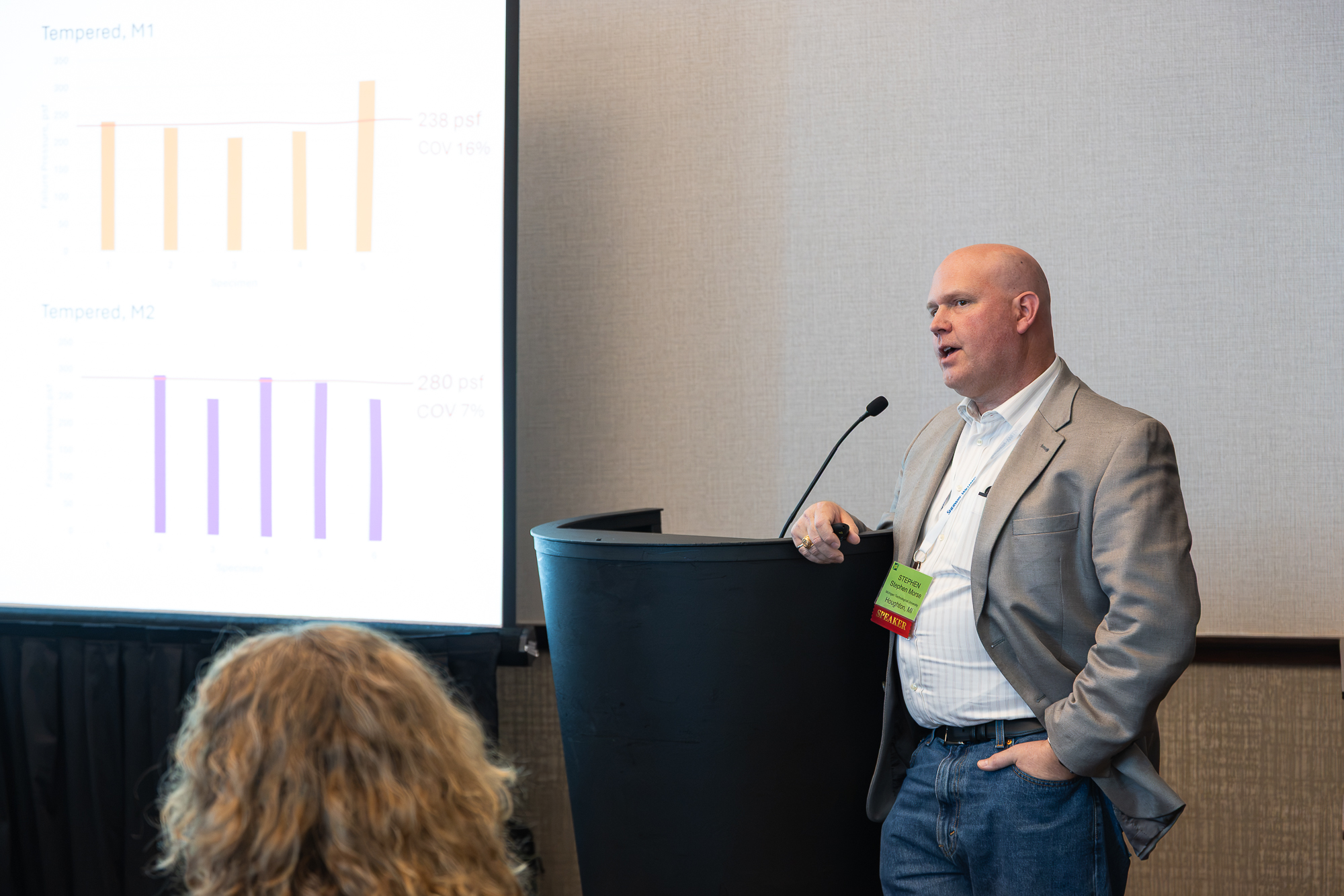 At the Fenestration & Glazing Industry Alliance (FGIA) Fall Conference in Calgary, Alberta, Dr. Stephen Morse, Michigan Technological University associate professor, delivered a critical update on the load resistance and durability of vacuum insulated glass (VIG) units. Conducted in partnership with FGIA and the National Glass Association (NGA), the study bridges a critical gap in architectural data by evaluating commercial-sized VIG units rather than idealized laboratory samples.
“We want to be able to inform engineers, architects and specifiers how to design these units to go in structures,” said Morse. For the process, he and his team created a frame in which they glazed specimens. Then, they applied a uniform pressure on the units until they failed. The pressure was measured along with the deflection.
Research Specifications
Once enough data is collected, Morse said researchers will use that information to build a model to assist with the design of glass for the durability and performance of VIG units. Eventually, a new ASTM standard will be developed based upon the research, providing a new tool for engineers and architects and establishing initial load resistance performance. “Until now, there wasn’t really any openly published data,” said Morse. “Thanks to funding from FGIA and NGA, we are able to get the ball rolling on publicly available info from a non-manufacturer, and from an impartial party.”
For the research, ASTM E997/ASTM E998 tests were performed on sample sets of VIG units from various manufacturers, constructions and geometries to assess their load resistance to uniform pressure. Three different specimen sizes were tested, ranging from sizes used in residential and commercial applications. Both annealed and tempered glass samples were tested. “We wanted to do these bigger sizes because no one has really done a commercial size with the thickness we used,” said Morse.
Future Development
VIGs tend to be very thin, said Morse, and their insulating factor is far beyond single glazed, or what has traditionally been used, which is double IG units. “Even though manufacturers are making [VIGs], engineers and architects don’t know how to use it for their projects,” said Morse. “This research will open up the market to allow for use of this much more efficient unit, in terms of thermal performance but also its weight.”
A report will be submitted to both Associations within the next few months, which will help inform next steps. “For example, should we use different sizes?” posed Morse. “Different construction? There may be other manufacturers who want us to repeat our tests with their products to add to that body of knowledge. We need enough data to be confident in a standard down the road.”
For more information about FGIA and its events, visit FGIAonline.org/events.
Your trusted industry resource, setting the standards for fenestration and glazing.
###
Filed under: Events, FGIA, Products