
Latest developments for ENERGY STAR Canada shared during FGIA Fall Conference
Posted on September 4th, 2026
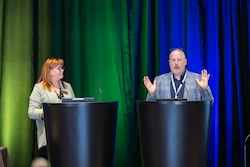
Hulan emphasized the government’s commitment to guiding the fenestration industry through a multi-level approach designed to accelerate market transformation across Canada. “Canadians are spending larger portions of their income on their energy bills. We noticed a 32% rise in energy poverty between 2019 and 2021,” said Hulan. “But there are three pillars of market transformation: information, incentives and regulations.”
Information
“Policy makers are seeing the role energy efficiency has in improving affordability,” said Hulan. When it comes to fenestration, Hulan said the link between energy efficiency and affordability is clear. “In Canadian homes, almost 60% of energy used is for space heating,” he said. “Up to 35% of home heat is lost through residential windows. Our role is to make use of interventions to help products get toward greater energy efficiency.”
Hulan acknowledged that the ENERGY STAR program has experienced challenges in the last year. “We are in a transitional period now as a result,” he said. “But the program’s mandate, roles, responsibilities and stakeholders remain in place during the transition.”
Hulan shared that while a draft of version 6 of ENERGY STAR Canada for energy efficient fenestration is ready, it has not yet been published – though it will be in the near future. He encouraged participants to get involved in that process once the draft is made public. “We put drafts out there to drive the conversations we need to have to get it as right as we can for the market,” said Hulan. “We will soon have information out about how to submit comments and participate in discussions.”
Incentives
“When it comes to energy efficient fenestration, we have some incentive programs to drive consumers to ENERGY STAR products,” said Hulan. “They benefit from being part of a clear, simple and recognized brand of products. We see demand shift in those product categories, therefore, shifting the market.”
Incentive programs include Canada Greener Homes Grant and Loan, which is administered in partnership with provinces and territories. This program offers a $125 grant for ENERGY STAR certified models or a $250 grant for ENERGY STAR Most Efficient certified models. “Windows and doors were the second most popular retrofit after heat pumps,” said Hulan. “Around 150,000 households installed windows or doors through this program.”
A non-monetary incentive called ENERGY STAR for New Homes (ENH) requires homes to have ENERGY STAR certified windows and skylights to achieve ENH certification. To date, around 100,000 homes in Canada have been certified under the ENERGY STAR for New Homes program.
Regulations
Building code energy efficiency requirements are another pillar of market shift, asserted Hulan. In Canada, that can be complex. “The fenestration market has domestic players that ship to different provinces,” said Hulan. “Federal rules do not apply to products that don’t leave province boundaries. There is a risk of creating an uneven playing field in the market between those that are imported beyond the international border and those that are not. It’s a challenge in terms of federal regulations. Labelling requirements are seen as an important first step to leverage all mechanisms to influence the market.”
Hulan shared that, in 2024, his organization explored a regulated standardized label for fenestration. “However, we decided in 2025 to pause this pursuit, and it was removed from the regulatory plan,” he said. “This was due to feedback from pre-consultations, and their points about the complexity of the market in Canada. Also, this decision was partly due to uncertainty about the future of ENERGY STAR, which felt precarious a year ago.”
In conclusion, Hulan shared that government and industry collaboration will always lead to a better result. “While our programs can be seen in isolation, they are best understood when seen as a package, working together and reinforcing each other,” he said. “Partnerships make it all possible.”
For more information about FGIA and its events, visit FGIAonline.org/events.
Your trusted industry resource, setting the standards for fenestration and glazing.
###
Filed under: Events, Products, FGIA