
Daylighting researcher shares updates, next steps for building codes, advocacy
Posted on September 2nd, 2026
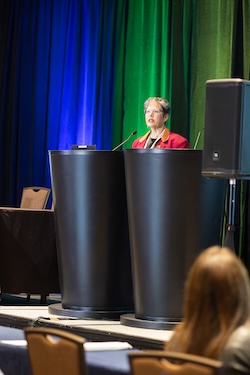
“Over the past 40 years, research has demonstrated that light plays a vital role in our health, mood, performance and sleep,” said Veitch. “Windows and skylights can provide both daylight and views, but North American building codes largely overlook these health benefits, despite some European jurisdictions already requiring daylight and window access in certain building types.”
Current Research
“Light affects health and well-being, but getting enough daytime light exposure is a problem for most people,” said Veitch. She delved into the science of how light is perceived by the human eye and noted that around 25 years ago, a new component of this was discovered: intrinsically photosensitive retinal ganglion cells, or ipRGCs.
“These send information about the presences of light to a wide variety of other parts of the brain,” she said. IpRGCs are different from the rods and cones, Veitch explained, noting that their function has a different spectral sensitivity. “It’s best described as ‘melanopic’,” she said. “It tells us that if we deliver light strongest in that area of the spectrum, it sends a stronger light to those ipRGCs, which we might not necessarily want.”
IpRGCs Recommendations
“Regardless of where you are in the world, you don’t get as much light exposure as you should,” said Veitch. Recommendations for daily light exposure for ipRGCs are, essentially, a need for bright days and dark nights, said Veitch.
“We want 250 lux of melanopic equivalent daylight illuminance (EDI) during the day…minimum,” she explained. “Not many offices meet this. For three hours before bed, you want to get down to 10 lux. When sleeping, you want a maximum of 1 lux at the eye. This is important for physiological functions.”
This distinction is not only related to getting quality sleep, she noted. “Our bodies can tell when it is time to be awake and active, and for our immune system to be ready to fight,” said Veitch. “At night, it’s time to slow down and for the immune system to shift into a ‘repair and healing’ mode.”
Energy Concerns

Quality Views
Veitch clarified that view quality matters, too, but that the view type is complicated. “Nature views can improve your impression of a space and that tends to reduce discomfort,” said Veitch. “But there is also a direct path between nature views and an increase in discomfort. View quality tended to reduce discomfort.” She lamented that, while not everyone can have a building with a nature view or an attractive view, it is a distinguishable benefit for the people who can.
Codes and Standards
“Europe is way ahead of most of the world,” said Veitch of building codes and standards when it comes to daylighting. She noted that Europe requires metrics, such as window dimensions and window-to-floor ration, as well as a daylight factor, which can be difficult to calculate. However, Europe has a standard to aid architects in this effort. Veitch pointed out that while the National Building Code of Canada (NBC) includes “health” as one of its five objectives, there is no mention of light or daylighting in its section on indoor conditions.
“I call upon you to advocate for this change,” she said. “Windows have extensive requirements, but the NBC does not talk about them in terms of daylighting.” She did, however, express hope for the U.S., as the International Building Code (IBC) will soon have updates about daylighting when it comes to classrooms as well as dorm rooms and apartments
Next Steps
“This is a team effort,” said Veitch.”More research is needed, as well as advocacy for that research.” It’s encouraging that FGIA has a way of funding research, she said, because strong evidence is needed to effect changes to codes. “The cost to the builder is considered, as well as the balance against energy costs,” she said. “Diverse populations, especially age groups, must also be considered.”
For more information about FGIA and its events, visit FGIAonline.org/events.
Your trusted industry resource, setting the standards for fenestration and glazing.
###